QUESTION IMAGE
Question
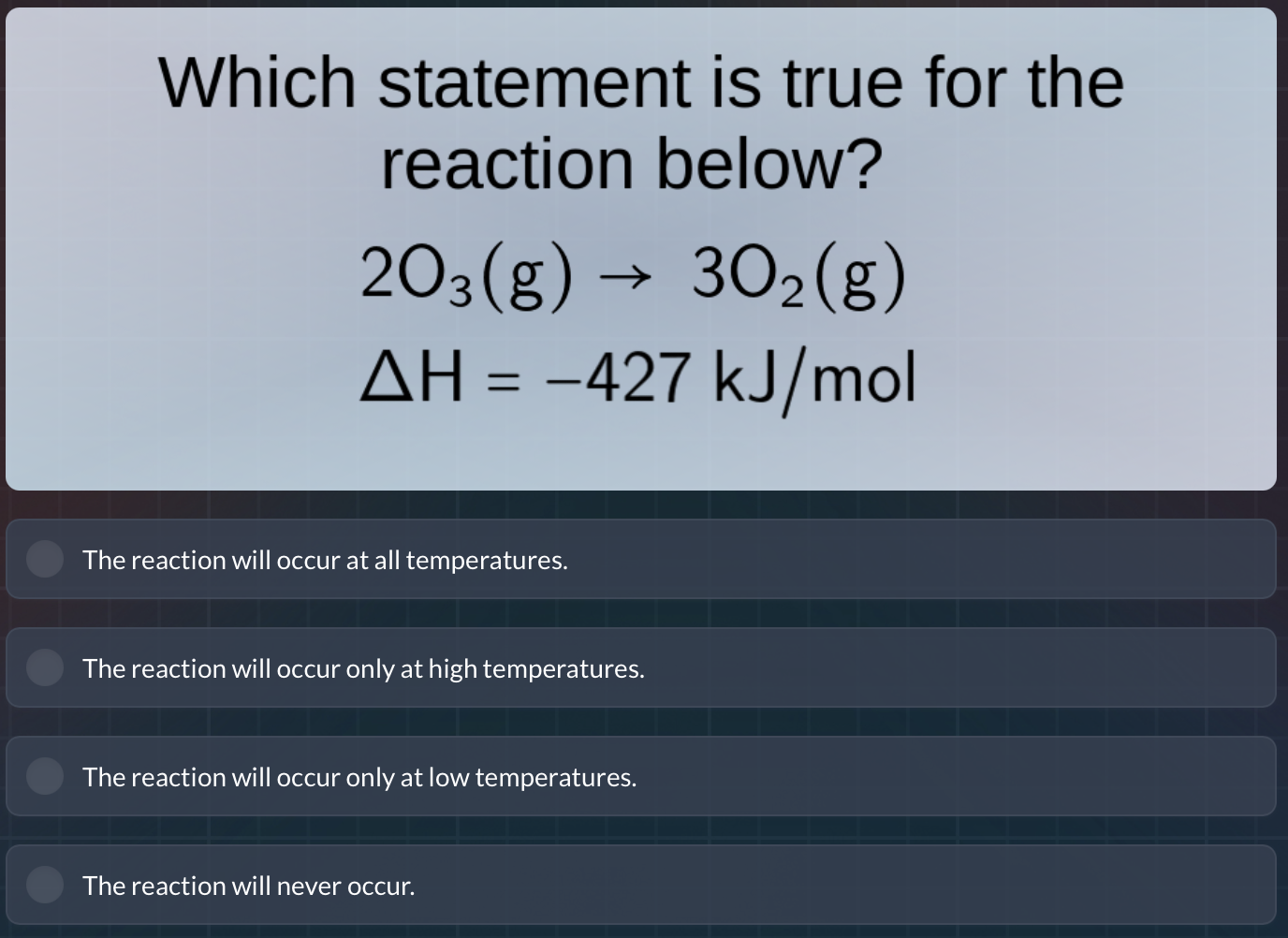
which statement is true for the reaction below?
$2\ce{o_3}(g) \
ightarrow 3\ce{o_2}(g)$
$\delta h = -427\\ \text{kj/mol}$
the reaction will occur at all temperatures.
the reaction will occur only at high temperatures.
the reaction will occur only at low temperatures.
the reaction will never occur.
To determine the temperature dependence of the reaction \( 2\text{O}_3(\text{g})
ightarrow 3\text{O}_2(\text{g}) \) with \( \Delta H = -427 \, \text{kJ/mol} \), we analyze the enthalpy (\( \Delta H \)) and entropy (\( \Delta S \)) changes:
- Enthalpy Change (\( \Delta H \)): The negative \( \Delta H \) (\( -427 \, \text{kJ/mol} \)) indicates the reaction is exothermic (releases heat).
- Entropy Change (\( \Delta S \)): The number of moles of gas increases (2 moles of \( \text{O}_3 \) produce 3 moles of \( \text{O}_2 \)), so \( \Delta S \) is positive (disorder increases).
For spontaneity, we use the Gibbs free energy equation: \( \Delta G = \Delta H - T\Delta S \). Since \( \Delta H < 0 \) (exothermic) and \( \Delta S > 0 \) (entropy increase), the term \( -T\Delta S \) will also be negative (because \( T \) is always positive in Kelvin). Thus, \( \Delta G \) will be negative (\( \Delta G < 0 \)) at all temperatures, meaning the reaction is spontaneous (will occur) regardless of temperature.

Snap & solve any problem in the app
Get step-by-step solutions on Sovi AI
Photo-based solutions with guided steps
Explore more problems and detailed explanations
The reaction will occur at all temperatures.