QUESTION IMAGE
Question
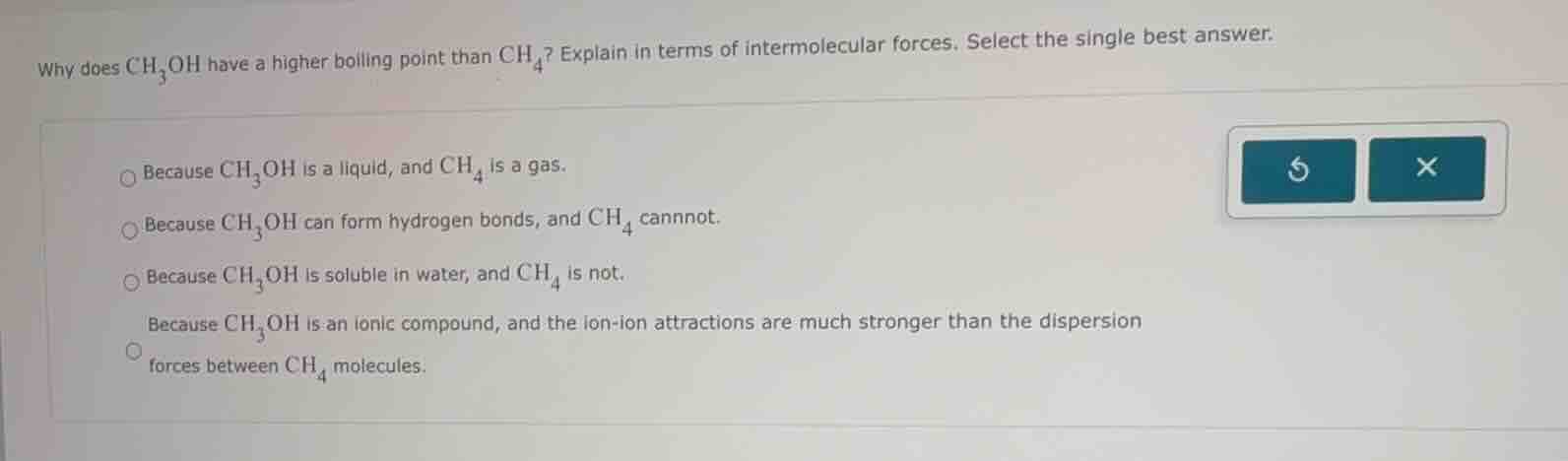
why does $ce{ch_3oh}$ have a higher boiling point than $ce{ch_4}$? explain in terms of intermolecular forces. select the single best answer.
- because $ce{ch_3oh}$ is a liquid, and $ce{ch_4}$ is a gas.
- because $ce{ch_3oh}$ can form hydrogen bonds, and $ce{ch_4}$ cannot.
- because $ce{ch_3oh}$ is soluble in water, and $ce{ch_4}$ is not.
- because $ce{ch_3oh}$ is an ionic compound, and the ion - ion attractions are much stronger than the dispersion forces between $ce{ch_4}$ molecules.
Brief Explanations
To determine why \( \text{CH}_3\text{OH} \) (methanol) has a higher boiling point than \( \text{CH}_4 \) (methane), we analyze the intermolecular forces:
- Option 1: Stating \( \text{CH}_3\text{OH} \) is liquid and \( \text{CH}_4 \) is gas describes their states, not the reason for differing boiling points (boiling point determines state, not vice versa). Eliminate.
- Option 2: \( \text{CH}_3\text{OH} \) has an \( -\text{OH} \) group, allowing hydrogen bonding (a strong intermolecular force). \( \text{CH}_4 \) is nonpolar and only has weak London dispersion forces. Stronger intermolecular forces require more energy to break, leading to a higher boiling point. This explains the difference.
- Option 3: Solubility in water relates to miscibility, not boiling point (boiling point depends on intermolecular forces within the substance, not with water). Eliminate.
- Option 4: \( \text{CH}_3\text{OH} \) is a covalent (molecular) compound, not ionic. Ionic bonding does not apply here. Eliminate.

Snap & solve any problem in the app
Get step-by-step solutions on Sovi AI
Photo-based solutions with guided steps
Explore more problems and detailed explanations
Because \( \text{CH}_3\text{OH} \) can form hydrogen bonds, and \( \text{CH}_4 \) cannot.