QUESTION IMAGE
Question
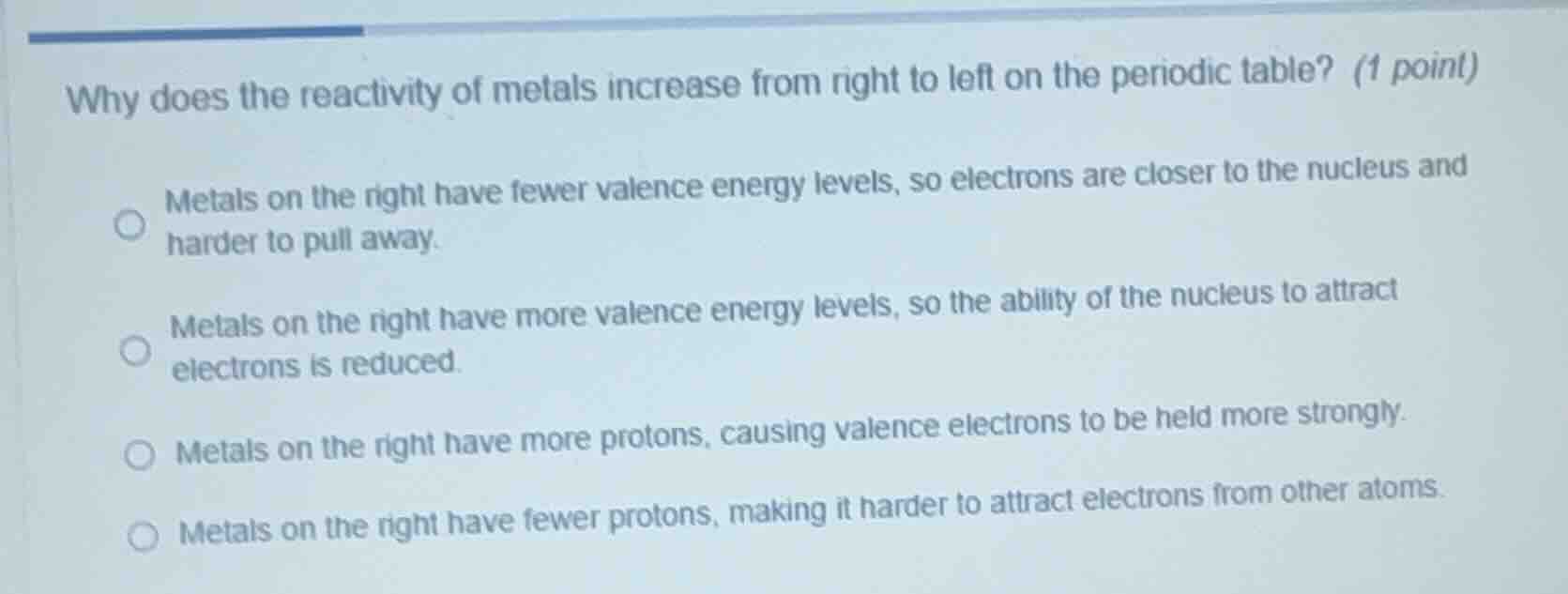
why does the reactivity of metals increase from right to left on the periodic table? (1 point)
metals on the right have fewer valence energy levels, so electrons are closer to the nucleus and harder to pull away.
metals on the right have more valence energy levels, so the ability of the nucleus to attract electrons is reduced.
metals on the right have more protons, causing valence electrons to be held more strongly.
metals on the right have fewer protons, making it harder to attract electrons from other atoms.
To determine the correct answer, we analyze each option:
- First option: Metals on the right (in the periodic table, for metals, we consider the left - right trend in groups/periods. Metals are mainly on the left. But for the trend from right to left among metals, as we move left, the number of valence energy levels generally decreases? No, actually, as we move left across a period, the number of valence energy levels remains the same (same period), but as we move down a group, it increases. Wait, for the reactivity of metals: metals tend to lose electrons. The easier it is to lose electrons, the more reactive the metal.
- For the first option: If metals on the right (less reactive metals) have fewer valence energy levels, electrons are closer to the nucleus and harder to pull away. This makes sense because if electrons are closer to the nucleus, the nuclear attraction is stronger, so it's harder to lose electrons (less reactive). As we move left, the number of valence electrons (in a period) decreases, and the effective nuclear charge on the valence electrons decreases (because there are fewer inner electrons shielding), but also, as we move left in a period, the atomic radius decreases? No, wait, in a period, from left to right, atomic radius decreases. Wait, maybe we should think in terms of groups. Metals are in groups 1, 2, and some transition metals. In group 1, as we go down the group (from top to bottom), reactivity increases because the valence electron is further from the nucleus (more energy levels), so easier to lose. But the question is about from right to left on the periodic table (so across a period, from right - non - metals/metalloids to left - metals).
- Let's re - evaluate the options:
- Option 1: "Metals on the right have fewer valence energy levels, so electrons are closer to the nucleus and harder to pull away." If a metal is on the right (e.g., in a period, like from right to left in period 3: from Cl (non - metal) to Na (metal)), as we move left, the atomic radius increases? No, in a period, from left to right, atomic radius decreases. Wait, Na is on the left of the period, Cl on the right. Na has a larger atomic radius than Cl. The valence electrons in Na are in the 3s orbital, Cl in 3p. The effective nuclear charge on Na's valence electron is less than on Cl's. So Na's valence electron is easier to lose (more reactive). So for the metals on the right (closer to non - metals in the period), like maybe Mg compared to Na (Na is left of Mg in period 3), Mg is to the right of Na. Mg has more protons than Na (atomic number of Na is 11, Mg is 12). The valence electrons in Mg are held more tightly than in Na? Wait, no, Na is more reactive than Mg. So the key is that as we move left in a period (from right to left), the metal becomes more reactive because it's easier to lose electrons.
- Option 2: "Metals on the right have more valence energy levels, so the ability of the nucleus to attract electrons is reduced." This is incorrect. In a period, the number of valence energy levels is the same.
- Option 3: "Metals on the right have more protons, causing valence electrons to be held more strongly." Let's take Na (left) and Mg (right) in period 3. Mg has more protons (12 vs 11) than Na. The valence electrons in Mg are held more strongly (higher ionization energy) than in Na. So Na (left) is more reactive than Mg (right). So metals on the right (like Mg) have more protons, hold valence electrons more strongly (harder to lose), so less reactive. As we move left (to Na), fewer protons? No, Na has fewe…

Snap & solve any problem in the app
Get step-by-step solutions on Sovi AI
Photo-based solutions with guided steps
Explore more problems and detailed explanations
C. Metals on the right have more protons, causing valence electrons to be held more strongly.