QUESTION IMAGE
Question
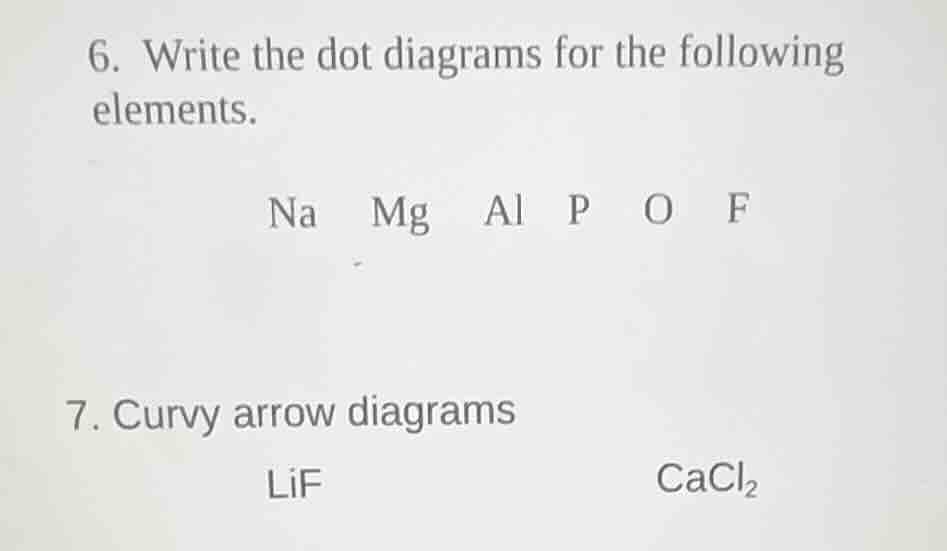
- write the dot diagrams for the following elements.
na mg al p o f
- curvy arrow diagrams
lif cacl₂
Question 6: Dot Diagrams (Lewis Dot Structures) for Elements
Lewis dot diagrams show the valence electrons of an atom as dots around the element symbol. Valence electrons are determined by the group number (for main - group elements, group number = number of valence electrons, except for Group 18 which has 8, except He with 2).
- Sodium (Na):
Na is in Group 1. So it has 1 valence electron.
Dot diagram: $\text{Na} \cdot$
- Magnesium (Mg):
Mg is in Group 2. So it has 2 valence electrons.
Dot diagram: $\text{Mg} \cdot \cdot$
- Aluminum (Al):
Al is in Group 13. So it has 3 valence electrons.
Dot diagram: $\text{Al} \cdot \cdot \cdot$
- Phosphorus (P):
P is in Group 15. So it has 5 valence electrons. We place one dot on each of the four sides first, then pair them.
Dot diagram: $\displaystyle \text{P} : \cdot \\ \quad \cdot$ (or more neatly, $\text{P} \cdot \cdot \\ \quad \cdot \cdot \cdot$ with the single dot at the top, two on the right, two on the bottom, and one on the left - the standard way is to have the dots distributed as $\text{P} \cdot \\ \cdot \cdot \\ \quad \cdot \cdot$ to show 5 valence electrons)
- Oxygen (O):
O is in Group 16. So it has 6 valence electrons.
Dot diagram: $\text{O} : \cdot \\ \quad \cdot \cdot$ (or $\text{O} \cdot \cdot \\ : \cdot \cdot$ - the standard is two pairs and two single dots, like $\text{O} : \cdot \\ \quad \cdot \cdot$ to represent 6 valence electrons)
- Fluorine (F):
F is in Group 17. So it has 7 valence electrons.
Dot diagram: $\text{F} : \cdot \\ : \cdot \cdot$ (or $\text{F} \cdot \cdot \\ : \cdot \cdot$ with one unpaired dot, representing 7 valence electrons)
Question 7: Curvy Arrow Diagrams for Ionic Compounds (Electron Transfer)
Ionic compounds form when electrons are transferred from a metal (cation) to a non - metal (anion). Curvy arrows show the transfer of electrons.
(a) Lithium Fluoride (LiF)
- Lithium (Li) is in Group 1, so it has 1 valence electron. Fluorine (F) is in Group 17, so it has 7 valence electrons.
- Li loses its 1 valence electron to F.
- Curvy arrow diagram:
We can represent Li as $\text{Li} \cdot$ and F as $\text{F} : \cdot \\ : \cdot \cdot$. The arrow goes from the dot (valence electron) of Li to F. After transfer, Li becomes $\text{Li}^+$ (no valence electrons shown) and F becomes $\text{F}^-$ with 8 valence electrons (an octet), so $\text{F}^- : \cdot \\ : \cdot \cdot \\ :$ (or $\text{[:F:]}^-$). The diagram with the arrow:
$\text{Li} \cdot \xrightarrow{\text{electron transfer}} \text{Li}^+$ and $\text{F} : \cdot \\ : \cdot \cdot \xleftarrow{\text{electron transfer}} \text{[:F:]}^-$
(b) Calcium Chloride ($\text{CaCl}_2$)
- Calcium (Ca) is in Group 2, so it has 2 valence electrons. Chlorine (Cl) is in Group 17, so each Cl has 7 valence electrons.
- Ca loses 2 valence electrons (one to each of two Cl atoms).
- Curvy arrow diagram:
Represent Ca as $\text{Ca} \cdot \cdot$, and each Cl as $\text{Cl} : \cdot \\ : \cdot \cdot$. One arrow goes from one dot of Ca to the first Cl, and another arrow goes from the second dot of Ca to the second Cl. After transfer, Ca becomes $\text{Ca}^{2+}$ (no valence electrons shown), and each Cl becomes $\text{Cl}^-$ with 8 valence electrons ( $\text{[:Cl:]}^-$). The diagram:
$\text{Ca} \cdot \cdot \xrightarrow{\text{electron transfer (1st electron)}} \text{Cl} : \cdot \\ : \cdot \cdot$ and $\text{Ca} \cdot \cdot \xrightarrow{\text{electron transfer (2nd electron)}} \text{Cl} : \cdot \\ : \cdot \cdot$ (more precisely, showing two Cl atoms: $\text{Ca} \cdot \cdot…

Snap & solve any problem in the app
Get step-by-step solutions on Sovi AI
Photo-based solutions with guided steps
Explore more problems and detailed explanations
Question 6: Dot Diagrams (Lewis Dot Structures) for Elements
Lewis dot diagrams show the valence electrons of an atom as dots around the element symbol. Valence electrons are determined by the group number (for main - group elements, group number = number of valence electrons, except for Group 18 which has 8, except He with 2).
- Sodium (Na):
Na is in Group 1. So it has 1 valence electron.
Dot diagram: $\text{Na} \cdot$
- Magnesium (Mg):
Mg is in Group 2. So it has 2 valence electrons.
Dot diagram: $\text{Mg} \cdot \cdot$
- Aluminum (Al):
Al is in Group 13. So it has 3 valence electrons.
Dot diagram: $\text{Al} \cdot \cdot \cdot$
- Phosphorus (P):
P is in Group 15. So it has 5 valence electrons. We place one dot on each of the four sides first, then pair them.
Dot diagram: $\displaystyle \text{P} : \cdot \\ \quad \cdot$ (or more neatly, $\text{P} \cdot \cdot \\ \quad \cdot \cdot \cdot$ with the single dot at the top, two on the right, two on the bottom, and one on the left - the standard way is to have the dots distributed as $\text{P} \cdot \\ \cdot \cdot \\ \quad \cdot \cdot$ to show 5 valence electrons)
- Oxygen (O):
O is in Group 16. So it has 6 valence electrons.
Dot diagram: $\text{O} : \cdot \\ \quad \cdot \cdot$ (or $\text{O} \cdot \cdot \\ : \cdot \cdot$ - the standard is two pairs and two single dots, like $\text{O} : \cdot \\ \quad \cdot \cdot$ to represent 6 valence electrons)
- Fluorine (F):
F is in Group 17. So it has 7 valence electrons.
Dot diagram: $\text{F} : \cdot \\ : \cdot \cdot$ (or $\text{F} \cdot \cdot \\ : \cdot \cdot$ with one unpaired dot, representing 7 valence electrons)
Question 7: Curvy Arrow Diagrams for Ionic Compounds (Electron Transfer)
Ionic compounds form when electrons are transferred from a metal (cation) to a non - metal (anion). Curvy arrows show the transfer of electrons.
(a) Lithium Fluoride (LiF)
- Lithium (Li) is in Group 1, so it has 1 valence electron. Fluorine (F) is in Group 17, so it has 7 valence electrons.
- Li loses its 1 valence electron to F.
- Curvy arrow diagram:
We can represent Li as $\text{Li} \cdot$ and F as $\text{F} : \cdot \\ : \cdot \cdot$. The arrow goes from the dot (valence electron) of Li to F. After transfer, Li becomes $\text{Li}^+$ (no valence electrons shown) and F becomes $\text{F}^-$ with 8 valence electrons (an octet), so $\text{F}^- : \cdot \\ : \cdot \cdot \\ :$ (or $\text{[:F:]}^-$). The diagram with the arrow:
$\text{Li} \cdot \xrightarrow{\text{electron transfer}} \text{Li}^+$ and $\text{F} : \cdot \\ : \cdot \cdot \xleftarrow{\text{electron transfer}} \text{[:F:]}^-$
(b) Calcium Chloride ($\text{CaCl}_2$)
- Calcium (Ca) is in Group 2, so it has 2 valence electrons. Chlorine (Cl) is in Group 17, so each Cl has 7 valence electrons.
- Ca loses 2 valence electrons (one to each of two Cl atoms).
- Curvy arrow diagram:
Represent Ca as $\text{Ca} \cdot \cdot$, and each Cl as $\text{Cl} : \cdot \\ : \cdot \cdot$. One arrow goes from one dot of Ca to the first Cl, and another arrow goes from the second dot of Ca to the second Cl. After transfer, Ca becomes $\text{Ca}^{2+}$ (no valence electrons shown), and each Cl becomes $\text{Cl}^-$ with 8 valence electrons ( $\text{[:Cl:]}^-$). The diagram:
$\text{Ca} \cdot \cdot \xrightarrow{\text{electron transfer (1st electron)}} \text{Cl} : \cdot \\ : \cdot \cdot$ and $\text{Ca} \cdot \cdot \xrightarrow{\text{electron transfer (2nd electron)}} \text{Cl} : \cdot \\ : \cdot \cdot$ (more precisely, showing two Cl atoms: $\text{Ca} \cdot \cdot
ightarrow \text{Cl} : \cdot \\ : \cdot \cdot$ (for the first Cl) and $\text{Ca} \cdot \cdot
ightarrow \text{Cl} : \cdot \\ : \cdot \cdot$ (for the second Cl), resulting in $\text{Ca}^{2+}$ and two $\text{[:Cl:]}^-$ ions)
Final Answers (Summarized)
Question 6 Dot Diagrams:
- $\text{Na}$: $\boldsymbol{\text{Na} \cdot}$
- $\text{Mg}$: $\boldsymbol{\text{Mg} \cdot \cdot}$
- $\text{Al}$: $\boldsymbol{\text{Al} \cdot \cdot \cdot}$
- $\text{P}$: $\boldsymbol{\text{P} \cdot \cdot \\ \quad \cdot \cdot \cdot}$ (or equivalent distribution for 5 valence electrons)
- $\text{O}$: $\boldsymbol{\text{O} : \cdot \\ \quad \cdot \cdot}$ (or equivalent for 6 valence electrons)
- $\text{F}$: $\boldsymbol{\text{F} : \cdot \\ : \cdot \cdot}$ (or equivalent for 7 valence electrons)
Question 7 Curvy Arrow Diagrams (Summary of Electron Transfer):
- $\text{LiF}$: Electron transfers from $\text{Li}$ (1 valence electron) to $\text{F}$, forming $\text{Li}^+$ and $\text{F}^-$.
- $\text{CaCl}_2$: Two electrons transfer from $\text{Ca}$ (one to each $\text{Cl}$), forming $\text{Ca}^{2+}$ and two $\text{Cl}^-$ ions. The curvy arrows show the direction of electron flow from the metal (Li, Ca) to the non - metal (F, Cl).