QUESTION IMAGE
Question
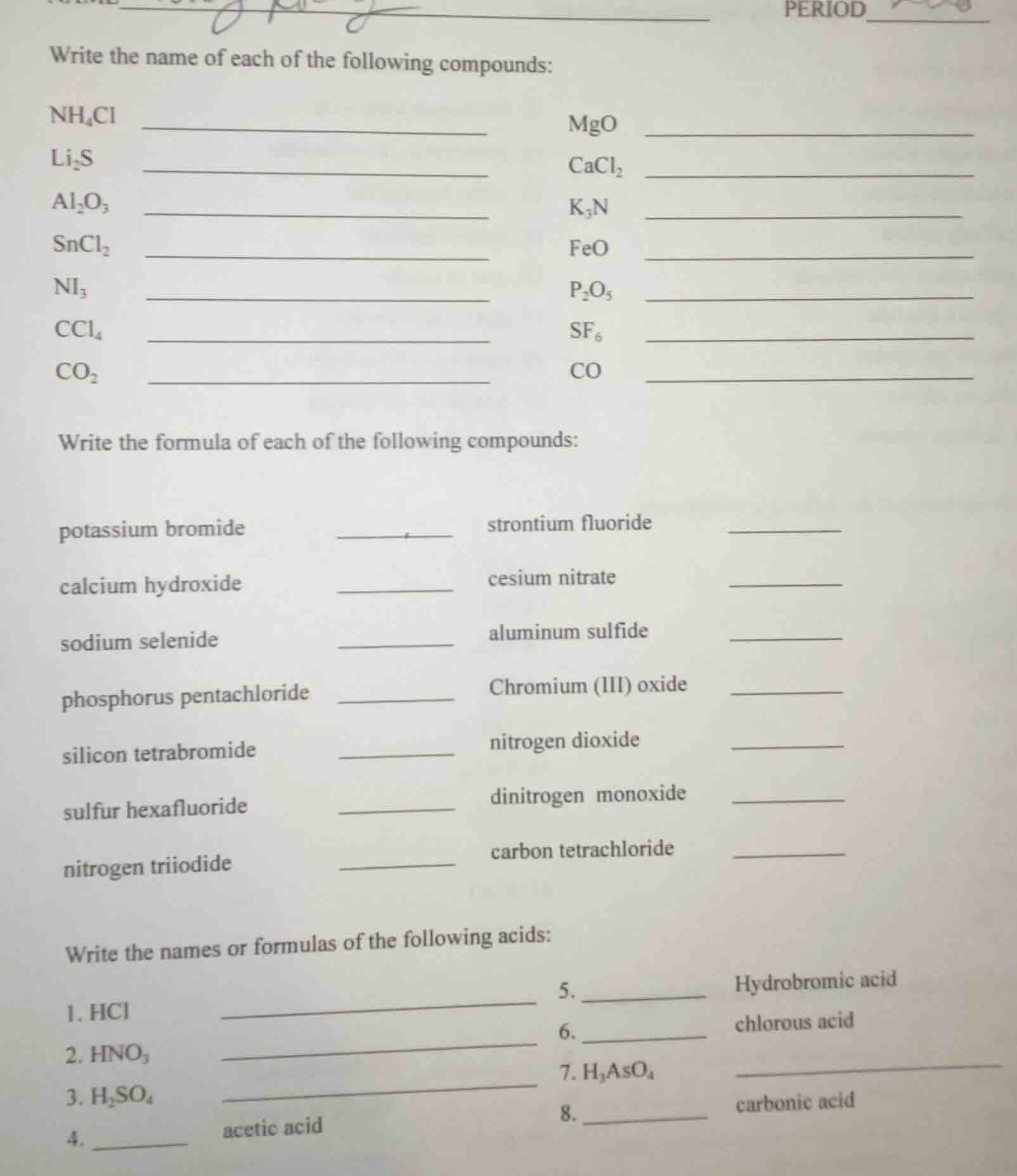
write the name of each of the following compounds:
nh₄cl
li₂s
al₂o₃
sncl₂
ni₃
ccl₄
co₂
mgo
cacl₂
k₃n
feo
p₂o₅
sf₆
co
write the formula of each of the following compounds:
potassium bromide
calcium hydroxide
sodium selenide
phosphorus pentachloride
silicon tetrabromide
sulfur hexafluoride
nitrogen triiodide
strontium fluoride
cesium nitrate
aluminum sulfide
chromium (iii) oxide
nitrogen dioxide
dinitrogen monoxide
carbon tetrachloride
write the names or formulas of the following acids:
- hcl
- hno₃
- h₂so₄
- acetic acid
- hydrobromic acid
- chlorous acid
- h₃aso₄
- carbonic acid
Part 1: Naming Compounds
1. $\ce{NH4Cl}$
Step1: Identify cation and anion.
Cation: $\ce{NH4+}$ (ammonium), Anion: $\ce{Cl-}$ (chloride).
Step2: Combine names.
Name: Ammonium chloride
2. $\ce{MgO}$
Step1: Identify ions.
Cation: $\ce{Mg^2+}$ (magnesium), Anion: $\ce{O^2-}$ (oxide).
Step2: Combine names (no prefixes for ionic compounds).
Name: Magnesium oxide
3. $\ce{Li2S}$
Step1: Identify ions.
Cation: $\ce{Li+}$ (lithium), Anion: $\ce{S^2-}$ (sulfide).
Step2: Balance charges (2 $\ce{Li+}$ for 1 $\ce{S^2-}$), then name.
Name: Lithium sulfide
4. $\ce{CaCl2}$
Step1: Identify ions.
Cation: $\ce{Ca^2+}$ (calcium), Anion: $\ce{Cl-}$ (chloride).
Step2: Balance charges (1 $\ce{Ca^2+}$ for 2 $\ce{Cl-}$), then name.
Name: Calcium chloride
5. $\ce{Al2O3}$
Step1: Identify ions.
Cation: $\ce{Al^3+}$ (aluminum), Anion: $\ce{O^2-}$ (oxide).
Step2: Balance charges (2 $\ce{Al^3+}$ for 3 $\ce{O^2-}$), then name.
Name: Aluminum oxide
6. $\ce{K3N}$
Step1: Identify ions.
Cation: $\ce{K+}$ (potassium), Anion: $\ce{N^3-}$ (nitride).
Step2: Balance charges (3 $\ce{K+}$ for 1 $\ce{N^3-}$), then name.
Name: Potassium nitride
7. $\ce{SnCl2}$
Step1: Identify ions.
Cation: $\ce{Sn^2+}$ (tin(II) or stannous), Anion: $\ce{Cl-}$ (chloride).
Step2: Use Roman numeral for variable charge.
Name: Tin(II) chloride (or Stannous chloride)
8. $\ce{FeO}$
Step1: Identify ions.
Cation: $\ce{Fe^2+}$ (iron(II) or ferrous), Anion: $\ce{O^2-}$ (oxide).
Step2: Use Roman numeral for variable charge.
Name: Iron(II) oxide (or Ferrous oxide)
9. $\ce{NI3}$
Step1: Identify as molecular (nonmetal-nonmetal). Use prefixes.
Prefixes: 1 = mono, 3 = tri.
Step2: Name first element (nitrogen), then second (iodine → iodide) with prefix.
Name: Nitrogen triiodide
10. $\ce{P2O5}$
Step1: Molecular compound. Prefixes: 2 = di, 5 = penta.
Step2: Name first element (phosphorus), then second (oxygen → oxide) with prefixes.
Name: Diphosphorus pentoxide
11. $\ce{CCl4}$
Step1: Molecular compound. Prefixes: 1 = mono (omitted for first element), 4 = tetra.
Step2: Name first element (carbon), then second (chlorine → chloride) with prefix.
Name: Carbon tetrachloride
12. $\ce{SF6}$
Step1: Molecular compound. Prefixes: 1 = mono (omitted), 6 = hexa.
Step2: Name first element (sulfur), then second (fluorine → fluoride) with prefix.
Name: Sulfur hexafluoride
13. $\ce{CO2}$
Step1: Molecular compound. Prefixes: 1 = mono (omitted), 2 = di.
Step2: Name first element (carbon), then second (oxygen → oxide) with prefix.
Name: Carbon dioxide
14. $\ce{CO}$
Step1: Molecular compound. Prefixes: 1 = mono (used for second element).
Step2: Name first element (carbon), then second (oxygen → oxide) with prefix.
Name: Carbon monoxide
Part 2: Writing Formulas
1. Potassium bromide
Step1: Identify ions: $\ce{K+}$ (potassium), $\ce{Br-}$ (bromide).
Step2: Balance charges (1:1 ratio).
Formula: $\ce{KBr}$
2. Strontium fluoride
Step1: Ions: $\ce{Sr^2+}$ (strontium), $\ce{F-}$ (fluoride).
Step2: Balance charges (1 $\ce{Sr^2+}$ for 2 $\ce{F-}$).
Formula: $\ce{SrF2}$
3. Calcium hydroxide
Step1: Ions: $\ce{Ca^2+}$ (calcium), $\ce{OH-}$ (hydroxide).
Step2: Balance charges (1 $\ce{Ca^2+}$ for 2 $\ce{OH-}$).
Formula: $\ce{Ca(OH)2}$
4. Cesium nitrate
Step1: Ions: $\ce{Cs+}$ (cesium), $\ce{NO3-}$ (nitrate).
Step2: Balance charges (1:1 ratio).
Formula: $\ce{CsNO3}$
5. Sodium selenide
Step1: Ions: $\ce{Na+}$ (sodium), $\ce{S…

Snap & solve any problem in the app
Get step-by-step solutions on Sovi AI
Photo-based solutions with guided steps
Explore more problems and detailed explanations
Part 1: Naming Compounds
1. $\ce{NH4Cl}$
Step1: Identify cation and anion.
Cation: $\ce{NH4+}$ (ammonium), Anion: $\ce{Cl-}$ (chloride).
Step2: Combine names.
Name: Ammonium chloride
2. $\ce{MgO}$
Step1: Identify ions.
Cation: $\ce{Mg^2+}$ (magnesium), Anion: $\ce{O^2-}$ (oxide).
Step2: Combine names (no prefixes for ionic compounds).
Name: Magnesium oxide
3. $\ce{Li2S}$
Step1: Identify ions.
Cation: $\ce{Li+}$ (lithium), Anion: $\ce{S^2-}$ (sulfide).
Step2: Balance charges (2 $\ce{Li+}$ for 1 $\ce{S^2-}$), then name.
Name: Lithium sulfide
4. $\ce{CaCl2}$
Step1: Identify ions.
Cation: $\ce{Ca^2+}$ (calcium), Anion: $\ce{Cl-}$ (chloride).
Step2: Balance charges (1 $\ce{Ca^2+}$ for 2 $\ce{Cl-}$), then name.
Name: Calcium chloride
5. $\ce{Al2O3}$
Step1: Identify ions.
Cation: $\ce{Al^3+}$ (aluminum), Anion: $\ce{O^2-}$ (oxide).
Step2: Balance charges (2 $\ce{Al^3+}$ for 3 $\ce{O^2-}$), then name.
Name: Aluminum oxide
6. $\ce{K3N}$
Step1: Identify ions.
Cation: $\ce{K+}$ (potassium), Anion: $\ce{N^3-}$ (nitride).
Step2: Balance charges (3 $\ce{K+}$ for 1 $\ce{N^3-}$), then name.
Name: Potassium nitride
7. $\ce{SnCl2}$
Step1: Identify ions.
Cation: $\ce{Sn^2+}$ (tin(II) or stannous), Anion: $\ce{Cl-}$ (chloride).
Step2: Use Roman numeral for variable charge.
Name: Tin(II) chloride (or Stannous chloride)
8. $\ce{FeO}$
Step1: Identify ions.
Cation: $\ce{Fe^2+}$ (iron(II) or ferrous), Anion: $\ce{O^2-}$ (oxide).
Step2: Use Roman numeral for variable charge.
Name: Iron(II) oxide (or Ferrous oxide)
9. $\ce{NI3}$
Step1: Identify as molecular (nonmetal-nonmetal). Use prefixes.
Prefixes: 1 = mono, 3 = tri.
Step2: Name first element (nitrogen), then second (iodine → iodide) with prefix.
Name: Nitrogen triiodide
10. $\ce{P2O5}$
Step1: Molecular compound. Prefixes: 2 = di, 5 = penta.
Step2: Name first element (phosphorus), then second (oxygen → oxide) with prefixes.
Name: Diphosphorus pentoxide
11. $\ce{CCl4}$
Step1: Molecular compound. Prefixes: 1 = mono (omitted for first element), 4 = tetra.
Step2: Name first element (carbon), then second (chlorine → chloride) with prefix.
Name: Carbon tetrachloride
12. $\ce{SF6}$
Step1: Molecular compound. Prefixes: 1 = mono (omitted), 6 = hexa.
Step2: Name first element (sulfur), then second (fluorine → fluoride) with prefix.
Name: Sulfur hexafluoride
13. $\ce{CO2}$
Step1: Molecular compound. Prefixes: 1 = mono (omitted), 2 = di.
Step2: Name first element (carbon), then second (oxygen → oxide) with prefix.
Name: Carbon dioxide
14. $\ce{CO}$
Step1: Molecular compound. Prefixes: 1 = mono (used for second element).
Step2: Name first element (carbon), then second (oxygen → oxide) with prefix.
Name: Carbon monoxide
Part 2: Writing Formulas
1. Potassium bromide
Step1: Identify ions: $\ce{K+}$ (potassium), $\ce{Br-}$ (bromide).
Step2: Balance charges (1:1 ratio).
Formula: $\ce{KBr}$
2. Strontium fluoride
Step1: Ions: $\ce{Sr^2+}$ (strontium), $\ce{F-}$ (fluoride).
Step2: Balance charges (1 $\ce{Sr^2+}$ for 2 $\ce{F-}$).
Formula: $\ce{SrF2}$
3. Calcium hydroxide
Step1: Ions: $\ce{Ca^2+}$ (calcium), $\ce{OH-}$ (hydroxide).
Step2: Balance charges (1 $\ce{Ca^2+}$ for 2 $\ce{OH-}$).
Formula: $\ce{Ca(OH)2}$
4. Cesium nitrate
Step1: Ions: $\ce{Cs+}$ (cesium), $\ce{NO3-}$ (nitrate).
Step2: Balance charges (1:1 ratio).
Formula: $\ce{CsNO3}$
5. Sodium selenide
Step1: Ions: $\ce{Na+}$ (sodium), $\ce{Se^2-}$ (selenide).
Step2: Balance charges (2 $\ce{Na+}$ for 1 $\ce{Se^2-}$).
Formula: $\ce{Na2Se}$
6. Aluminum sulfide
Step1: Ions: $\ce{Al^3+}$ (aluminum), $\ce{S^2-}$ (sulfide).
Step2: Balance charges (2 $\ce{Al^3+}$ for 3 $\ce{S^2-}$ → crisscross: 2 and 3).
Formula: $\ce{Al2S3}$
7. Phosphorus pentachloride
Step1: Molecular compound. Prefixes: penta = 5.
Step2: Phosphorus (P) + Chloride (Cl) with prefix.
Formula: $\ce{PCl5}$
8. Chromium(III) oxide
Step1: Ions: $\ce{Cr^3+}$ (chromium(III)), $\ce{O^2-}$ (oxide).
Step2: Balance charges (2 $\ce{Cr^3+}$ for 3 $\ce{O^2-}$).
Formula: $\ce{Cr2O3}$
9. Silicon tetrabromide
Step1: Molecular compound. Prefixes: tetra = 4.
Step2: Silicon (Si) + Bromide (Br) with prefix.
Formula: $\ce{SiBr4}$
10. Nitrogen dioxide
Step1: Molecular compound. Prefixes: di = 2.
Step2: Nitrogen (N) + Oxide (O) with prefix.
Formula: $\ce{NO2}$
11. Sulfur hexafluoride
Step1: Molecular compound. Prefixes: hexa = 6.
Step2: Sulfur (S) + Fluoride (F) with prefix.
Formula: $\ce{SF6}$
12. Dinitrogen monoxide
Step1: Molecular compound. Prefixes: di = 2, mono = 1.
Step2: Nitrogen (N) + Oxide (O) with prefixes.
Formula: $\ce{N2O}$
13. Nitrogen triiodide
Step1: Molecular compound. Prefixes: tri = 3.
Step2: Nitrogen (N) + Iodide (I) with prefix.
Formula: $\ce{NI3}$
14. Carbon tetrachloride
Step1: Molecular compound. Prefixes: tetra = 4.
Step2: Carbon (C) + Chloride (Cl) with prefix.
Formula: $\ce{CCl4}$
Part 3: Acids (Names/Formulas)
1. $\ce{HCl}$
Step1: Binary acid (H + nonmetal). Name: Hydro- + nonmetal root + -ic acid.
Step2: Chlorine → chlor + ic acid.
Name: Hydrochloric acid
2. $\ce{HNO3}$
Step1: Oxyacid (contains polyatomic ion $\ce{NO3-}$ (nitrate)). Name: Root + -ic acid.
Step2: Nitrate → nitric acid.
Name: Nitric acid
3. $\ce{H2SO4}$
Step1: Oxyacid (polyatomic ion $\ce{SO4^2-}$ (sulfate)). Name: Root + -ic acid.
Step2: Sulfate → sulfuric acid.
Name: Sulfuric acid
4. Acetic acid
Step1: Common name. Formula: $\ce{CH3COOH}$ (or $\ce{C2H4O2}$).
Formula: $\ce{CH3COOH}$ (or $\ce{C2H4O2}$)
5. Hydrobromic acid
Step1: Binary acid. Formula: H + Br (1:1 ratio).
Formula: $\ce{HBr}$
6. Chlorous acid
Step1: Oxyacid (polyatomic ion $\ce{ClO2-}$ (chlorite)). Name: Root + -ous acid.
Step2: Chlorite → chlorous acid. Formula: $\ce{HClO2}$
Formula: $\ce{HClO2}$
7. $\ce{H3AsO4}$
Step1: Oxyacid (polyatomic ion $\ce{AsO4^3-}$ (arsenate)). Name: Root + -ic acid.
Step2: Arsenate → arsenic acid.
Name: Arsenic acid
8. Carbonic acid
Step1: Oxyacid (polyatomic ion $\ce{CO3^2-}$ (carbonate)). Formula: $\ce{H2CO3}$ (2 H+ for 1 $\ce{CO3^2-}$).
Formula: $\ce{H2CO3}$
Final Answers (Selected Examples)
(Note: For brevity, here are key answers. Full answers follow the steps above.)
- $\ce{NH4Cl}$: Ammonium chloride
- $\ce{MgO}$: Magnesium oxide
- Potassium bromide: $\ce{KBr}$
- $\ce{HCl}$: Hydrochloric acid
- Acetic acid: $\ce{CH3COOH}$
(Complete answers for all compounds follow the step-by-step logic above.)