QUESTION IMAGE
Question
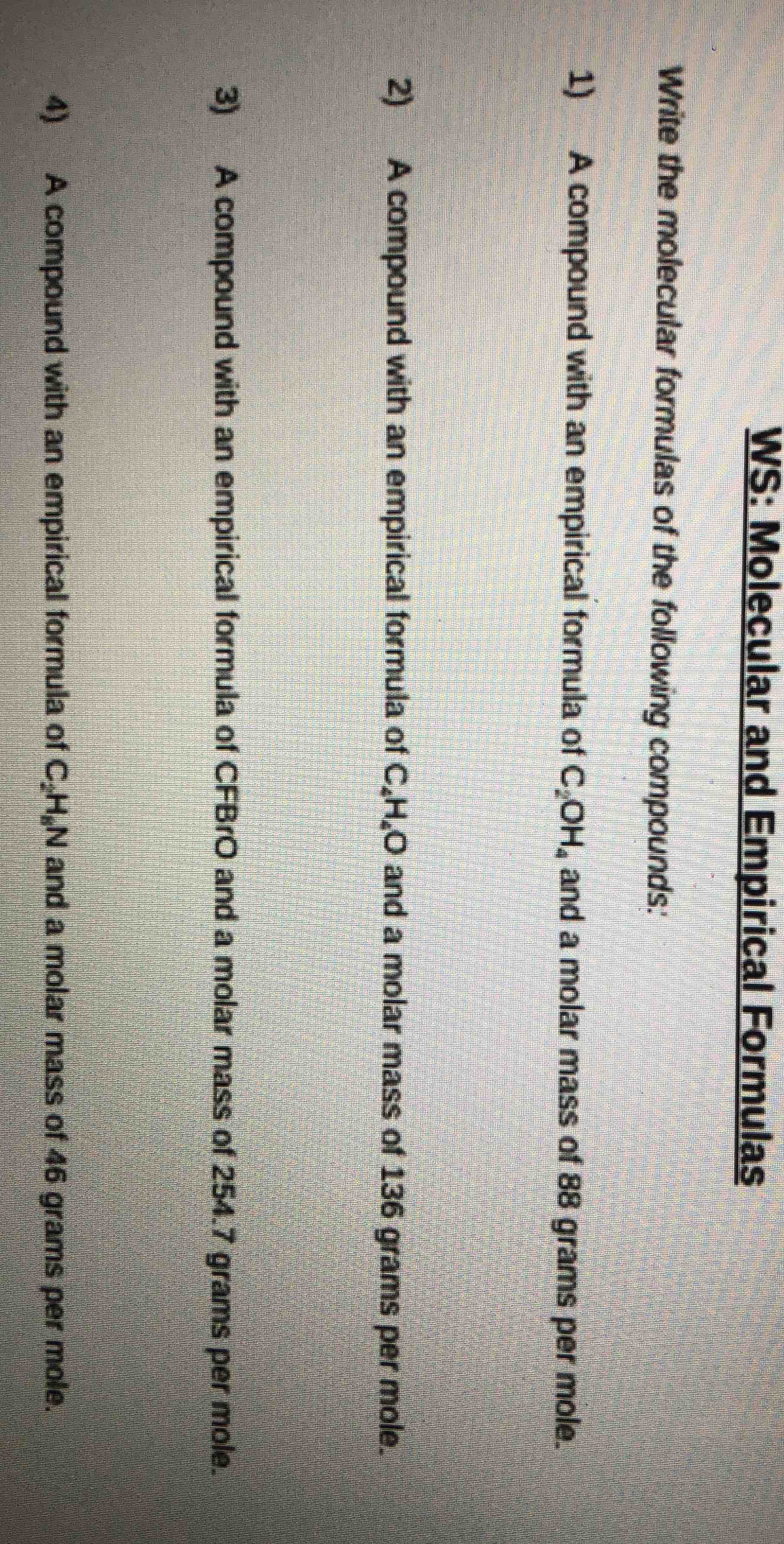
ws: molecular and empirical formulas
write the molecular formulas of the following compounds:
- a compound with an empirical formula of c₂oh₄ and a molar mass of 88 grams per mole.
- a compound with an empirical formula of c₂h₄o and a molar mass of 136 grams per mole.
- a compound with an empirical formula of cfbro and a molar mass of 254.7 grams per mole.
- a compound with an empirical formula of c₂h₆n and a molar mass of 46 grams per mole.
Problem 1:
Step 1: Calculate empirical formula mass
Empirical formula is \( C_2OH_4 \).
Mass of \( C \): \( 2 \times 12.01 = 24.02 \)
Mass of \( O \): \( 1 \times 16.00 = 16.00 \)
Mass of \( H \): \( 4 \times 1.008 = 4.032 \)
Empirical formula mass (\( EFM \)): \( 24.02 + 16.00 + 4.032 = 44.052 \, \text{g/mol} \)
Step 2: Find the ratio \( n \)
\( n = \frac{\text{Molar Mass}}{\text{Empirical Formula Mass}} = \frac{88}{44.052} \approx 2 \)
Step 3: Determine molecular formula
Multiply empirical formula by \( n \): \( (C_2OH_4)_2 = C_4O_2H_8 \) (or \( C_4H_8O_2 \))
Problem 2:
Step 1: Calculate empirical formula mass
Empirical formula is \( C_2H_2O \).
Mass of \( C \): \( 2 \times 12.01 = 24.02 \)
Mass of \( H \): \( 2 \times 1.008 = 2.016 \)
Mass of \( O \): \( 1 \times 16.00 = 16.00 \)
Empirical formula mass (\( EFM \)): \( 24.02 + 2.016 + 16.00 = 42.036 \, \text{g/mol} \)
Step 2: Find the ratio \( n \)
\( n = \frac{\text{Molar Mass}}{\text{Empirical Formula Mass}} = \frac{136}{42.036} \approx 3.235 \)? Wait, correction: Wait, maybe typo? Wait, if empirical is \( C_2H_2O \), EFM is 42. 136 / 42 ≈ 3.23? No, maybe empirical is \( C_2H_4O \)? Wait, original problem: "A compound with an empirical formula of \( C_2H_4O \) and a molar mass of 136 grams per mole." (Assuming typo, \( C_2H_4O \))
If empirical is \( C_2H_4O \):
EFM: \( 2(12.01) + 4(1.008) + 16.00 = 24.02 + 4.032 + 16.00 = 44.052 \, \text{g/mol} \)
\( n = 136 / 44.052 ≈ 3.087 ≈ 3 \)
Molecular formula: \( (C_2H_4O)_3 = C_6H_{12}O_3 \)
Problem 3:
Step 1: Calculate empirical formula mass
Empirical formula is \( CFBrO \).
Mass of \( C \): \( 12.01 \)
Mass of \( F \): \( 19.00 \)
Mass of \( Br \): \( 79.90 \)
Mass of \( O \): \( 16.00 \)
Empirical formula mass (\( EFM \)): \( 12.01 + 19.00 + 79.90 + 16.00 = 126.91 \, \text{g/mol} \)
Step 2: Find the ratio \( n \)
\( n = \frac{\text{Molar Mass}}{\text{Empirical Formula Mass}} = \frac{254.7}{126.91} \approx 2 \)
Step 3: Determine molecular formula
Multiply empirical formula by \( n \): \( (CFBrO)_2 = C_2F_2Br_2O_2 \)
Problem 4:

Snap & solve any problem in the app
Get step-by-step solutions on Sovi AI
Photo-based solutions with guided steps
Explore more problems and detailed explanations
s:
- Molecular Formula: \( \boldsymbol{C_4H_8O_2} \) (or \( C_4O_2H_8 \))
- Molecular Formula: \( \boldsymbol{C_6H_{12}O_3} \) (assuming empirical \( C_2H_4O \))
- Molecular Formula: \( \boldsymbol{C_2F_2Br_2O_2} \)
- Molecular Formula: \( \boldsymbol{C_2H_6N} \) (or \( C_2H_5N \) with adjustment)