QUESTION IMAGE
Question
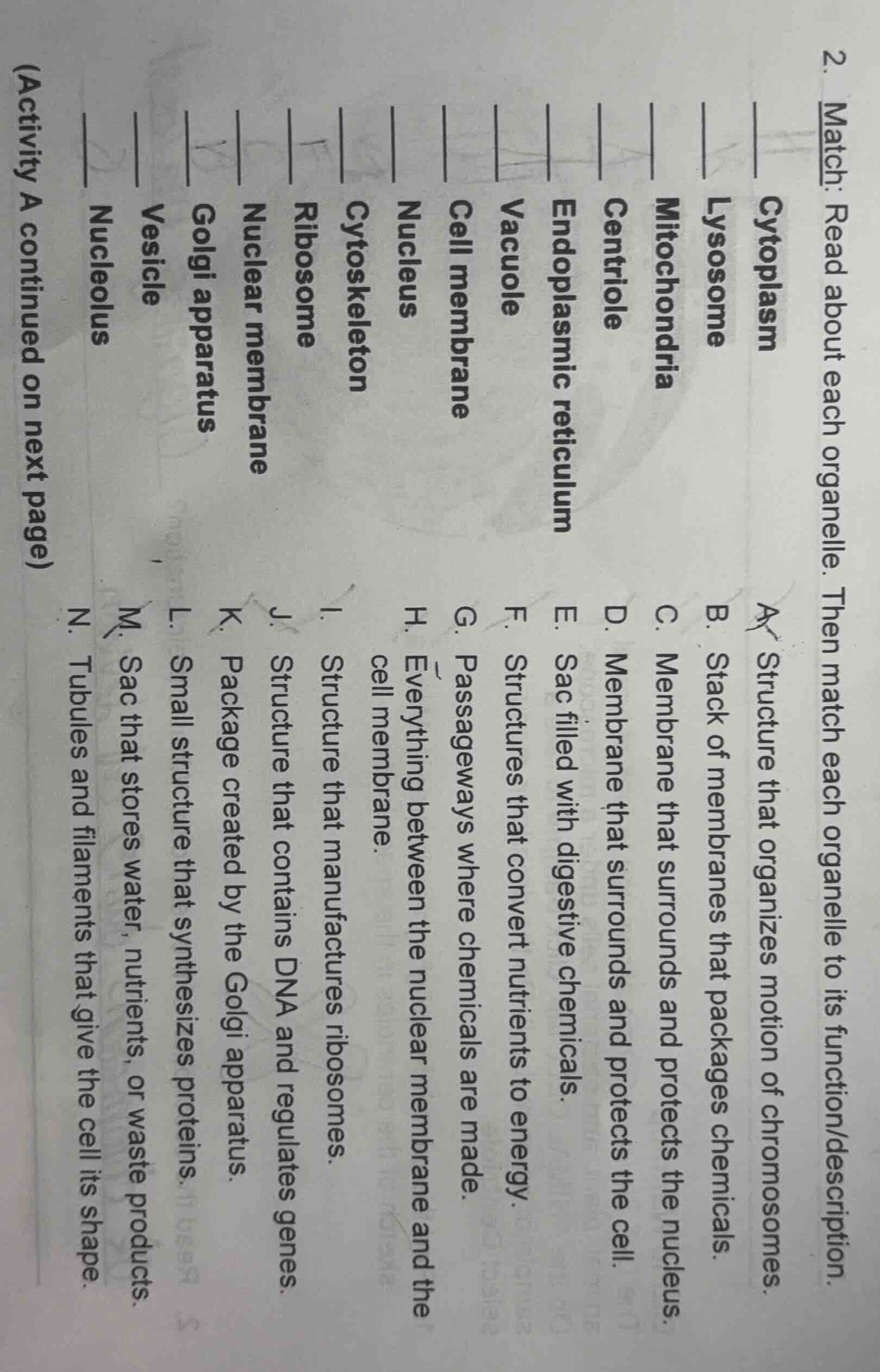
- match: read about each organelle. then match each organelle to its function/description.
cytoplasm a structure that organizes motion of chromosomes.
lysosome b stack of membranes that packages chemicals.
mitochondria c membrane that surrounds and protects the nucleus.
centriole d membrane that surrounds and protects the cell.
endoplasmic reticulum e sac filled with digestive chemicals.
vacuole f structures that convert nutrients to energy.
cell membrane g passageways where chemicals are made.
nucleus h everything between the nuclear membrane and the cell membrane.
cytoskeleton i structure that manufactes ribosomes.
ribosome j structure that contains dna and regulates genes.
nuclear membrane k package created by the golgi apparatus.
golgi apparatus l small structure that synthesizes proteins.
vesicle m sac that stores water, nutrients, or waste products.
nucleolus n tubules and filaments that give the cell its shape.
(activity a continued on next page)
To solve this organelle - function matching problem, we analyze each organelle and its corresponding function description:
1. Cytoplasm
The function description for cytoplasm is "Everything between the nuclear membrane and the cell membrane" (option H). So, Cytoplasm - H.
2. Lysosome
Lysosome is a "Sac filled with digestive chemicals" (option E). So, Lysosome - E.
3. Mitochondria
Mitochondria are structures that "convert nutrients to energy" (option F). So, Mitochondria - F.
4. Centriole
Centriole is a "Structure that organizes motion of chromosomes" (option A). So, Centriole - A.
5. Endoplasmic Reticulum
Endoplasmic Reticulum has "Passageways where chemicals are made" (option G). So, Endoplasmic Reticulum - G.
6. Vacuole
Vacuole is a "Sac that stores water, nutrients, or waste products" (option M). So, Vacuole - M.
7. Cell membrane
Cell membrane is a "Membrane that surrounds and protects the cell" (option D). So, Cell membrane - D.
8. Nucleus
Nucleus is a "Structure that contains DNA and regulates genes" (option J). So, Nucleus - J.
9. Cytoskeleton
Cytoskeleton consists of "Tubules and filaments that give the cell its shape" (option N). So, Cytoskeleton - N.
10. Ribosome
Ribosome is a "Small structure that synthesizes proteins" (option L). So, Ribosome - L.
11. Nuclear membrane
Nuclear membrane is a "Membrane that surrounds and protects the nucleus" (option C). So, Nuclear membrane - C.
12. Golgi apparatus
Golgi apparatus is a "Stack of membranes that packages chemicals" (option B). So, Golgi apparatus - B.
13. Vesicle
Vesicle is a "Package created by the Golgi apparatus" (option K). So, Vesicle - K.
14. Nucleolus
Nucleolus is a "Structure that manufactures ribosomes" (option I). So, Nucleolus - I.
Final Matches:
- Cytoplasm - H
- Lysosome - E
- Mitochondria - F
- Centriole - A
- Endoplasmic Reticulum - G
- Vacuole - M
- Cell membrane - D
- Nucleus - J
- Cytoskeleton - N
- Ribosome - L
- Nuclear membrane - C
- Golgi apparatus - B
- Vesicle - K
- Nucleolus - I

Snap & solve any problem in the app
Get step-by-step solutions on Sovi AI
Photo-based solutions with guided steps
Explore more problems and detailed explanations
To solve this organelle - function matching problem, we analyze each organelle and its corresponding function description:
1. Cytoplasm
The function description for cytoplasm is "Everything between the nuclear membrane and the cell membrane" (option H). So, Cytoplasm - H.
2. Lysosome
Lysosome is a "Sac filled with digestive chemicals" (option E). So, Lysosome - E.
3. Mitochondria
Mitochondria are structures that "convert nutrients to energy" (option F). So, Mitochondria - F.
4. Centriole
Centriole is a "Structure that organizes motion of chromosomes" (option A). So, Centriole - A.
5. Endoplasmic Reticulum
Endoplasmic Reticulum has "Passageways where chemicals are made" (option G). So, Endoplasmic Reticulum - G.
6. Vacuole
Vacuole is a "Sac that stores water, nutrients, or waste products" (option M). So, Vacuole - M.
7. Cell membrane
Cell membrane is a "Membrane that surrounds and protects the cell" (option D). So, Cell membrane - D.
8. Nucleus
Nucleus is a "Structure that contains DNA and regulates genes" (option J). So, Nucleus - J.
9. Cytoskeleton
Cytoskeleton consists of "Tubules and filaments that give the cell its shape" (option N). So, Cytoskeleton - N.
10. Ribosome
Ribosome is a "Small structure that synthesizes proteins" (option L). So, Ribosome - L.
11. Nuclear membrane
Nuclear membrane is a "Membrane that surrounds and protects the nucleus" (option C). So, Nuclear membrane - C.
12. Golgi apparatus
Golgi apparatus is a "Stack of membranes that packages chemicals" (option B). So, Golgi apparatus - B.
13. Vesicle
Vesicle is a "Package created by the Golgi apparatus" (option K). So, Vesicle - K.
14. Nucleolus
Nucleolus is a "Structure that manufactures ribosomes" (option I). So, Nucleolus - I.
Final Matches:
- Cytoplasm - H
- Lysosome - E
- Mitochondria - F
- Centriole - A
- Endoplasmic Reticulum - G
- Vacuole - M
- Cell membrane - D
- Nucleus - J
- Cytoskeleton - N
- Ribosome - L
- Nuclear membrane - C
- Golgi apparatus - B
- Vesicle - K
- Nucleolus - I