QUESTION IMAGE
Question
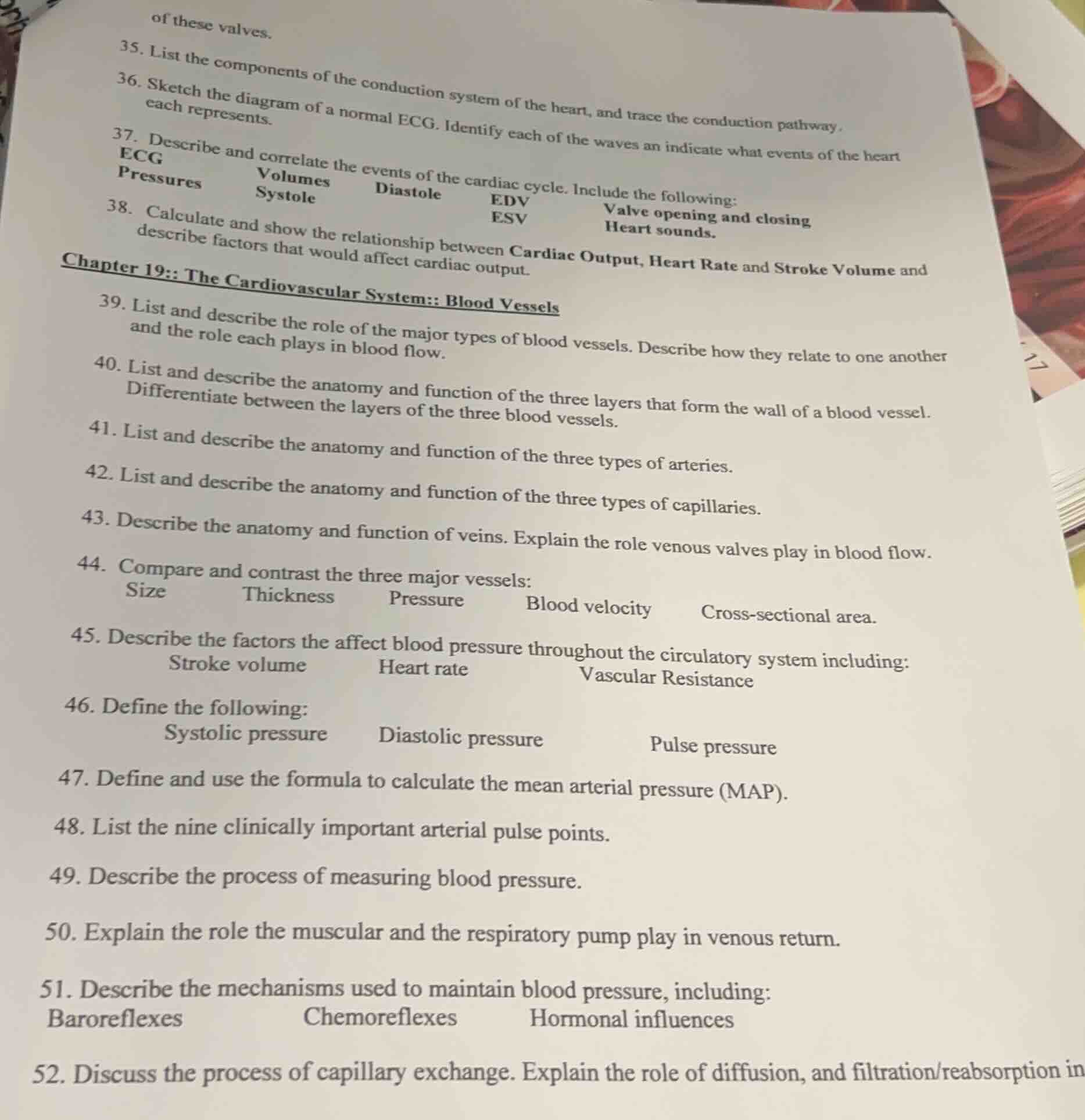
of these valves.
- list the components of the conduction system of the heart, and trace the conduction pathway.
- sketch the diagram of a normal ecg. identify each of the waves an indicate what events of the heart each represents.
- describe and correlate the events of the cardiac cycle. include the following:
ecg volumes diastole edv valve opening and closing
pressures systole esv heart sounds.
- calculate and show the relationship between cardiac output, heart rate and stroke volume and describe factors that would affect cardiac output.
chapter 19:: the cardiovascular system:: blood vessels
- list and describe the role of the major types of blood vessels. describe how they relate to one another and the role each plays in blood flow.
- list and describe the anatomy and function of the three layers that form the wall of a blood vessel. differentiate between the layers of the three blood vessels.
- list and describe the anatomy and function of the three types of arteries.
- list and describe the anatomy and function of the three types of capillaries.
- describe the anatomy and function of veins. explain the role venous valves play in blood flow.
- compare and contrast the three major vessels:
size thickness pressure blood velocity cross - sectional area.
- describe the factors the affect blood pressure throughout the circulatory system including:
stroke volume heart rate vascular resistance
- define the following:
systolic pressure diastolic pressure pulse pressure
- define and use the formula to calculate the mean arterial pressure (map).
- list the nine clinically important arterial pulse points.
- describe the process of measuring blood pressure.
- explain the role the muscular and the respiratory pump play in venous return.
- describe the mechanisms used to maintain blood pressure, including:
baroreflexes chemoreflexes hormonal influences
- discuss the process of capillary exchange. explain the role of diffusion, and filtration/reabsorption in
To solve question 47 (Define and use the formula to calculate the mean arterial pressure (MAP)):
Step 1: Define Mean Arterial Pressure (MAP)
Mean Arterial Pressure (MAP) is the average pressure in a person's arteries during one cardiac cycle. It is an important measure of perfusion pressure to organs and tissues.
Step 2: Recall the Formula for MAP
The formula to calculate MAP is:
$$\text{MAP} = \text{Diastolic Pressure} + \frac{1}{3} \times (\text{Systolic Pressure} - \text{Diastolic Pressure})$$
This can also be written as:
$$\text{MAP} = \frac{2 \times \text{Diastolic Pressure} + \text{Systolic Pressure}}{3}$$
Step 3: Example Calculation (Optional, but helps illustrate)
Suppose a person has a systolic pressure of $120 \, \text{mmHg}$ and a diastolic pressure of $80 \, \text{mmHg}$.
Using the formula:
$$\text{MAP} = 80 + \frac{1}{3} \times (120 - 80)$$
$$\text{MAP} = 80 + \frac{1}{3} \times 40$$
$$\text{MAP} = 80 + 13.33$$
$$\text{MAP} \approx 93.33 \, \text{mmHg}$$

Snap & solve any problem in the app
Get step-by-step solutions on Sovi AI
Photo-based solutions with guided steps
Explore more problems and detailed explanations
- Definition: Mean Arterial Pressure (MAP) is the average pressure in the arteries over one cardiac cycle, representing the perfusion pressure to organs.
- Formula: $\boldsymbol{\text{MAP} = \text{Diastolic Pressure} + \frac{1}{3} \times (\text{Systolic Pressure} - \text{Diastolic Pressure})}$ (or $\boldsymbol{\text{MAP} = \frac{2 \times \text{Diastolic Pressure} + \text{Systolic Pressure}}{3}}$).
- Example Calculation (for systolic = $120 \, \text{mmHg}$, diastolic = $80 \, \text{mmHg}$): $\text{MAP} \approx 93.33 \, \text{mmHg}$ (calculation shown above).