QUESTION IMAGE
Question
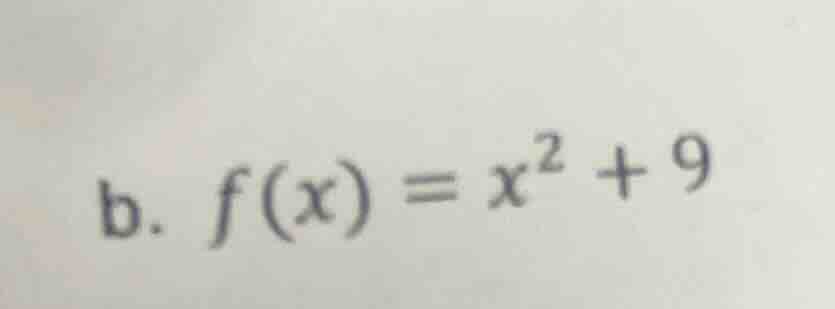
b. f(x) = x² + 9
Assuming the problem is to find the derivative of \( f(x)=x^{2}+9 \) (a common calculus task with such a function):
Step1: Recall power rule for derivatives
The power rule states that if \( y = x^n \), then \( y'=nx^{n - 1} \). Also, the derivative of a constant \( c \) is \( 0 \), i.e., \( \frac{d}{dx}(c)=0 \).
Step2: Differentiate term by term
For the term \( x^{2} \), using the power rule with \( n = 2 \), we get \( \frac{d}{dx}(x^{2})=2x^{2-1}=2x \).
For the term \( 9 \) (a constant), its derivative is \( \frac{d}{dx}(9) = 0 \).
Step3: Combine the derivatives
The derivative of \( f(x)=x^{2}+9 \) is the sum of the derivatives of its terms: \( f'(x)=2x + 0=2x \).

Snap & solve any problem in the app
Get step-by-step solutions on Sovi AI
Photo-based solutions with guided steps
Explore more problems and detailed explanations
If finding the derivative, the derivative \( f'(x)=2x \); if other operations (like finding roots, domain, etc.) were intended, more context is needed. But for the common calculus task of differentiation, the derivative is \( \boldsymbol{2x} \).