QUESTION IMAGE
Question
name
class date
8-3 practice
form k
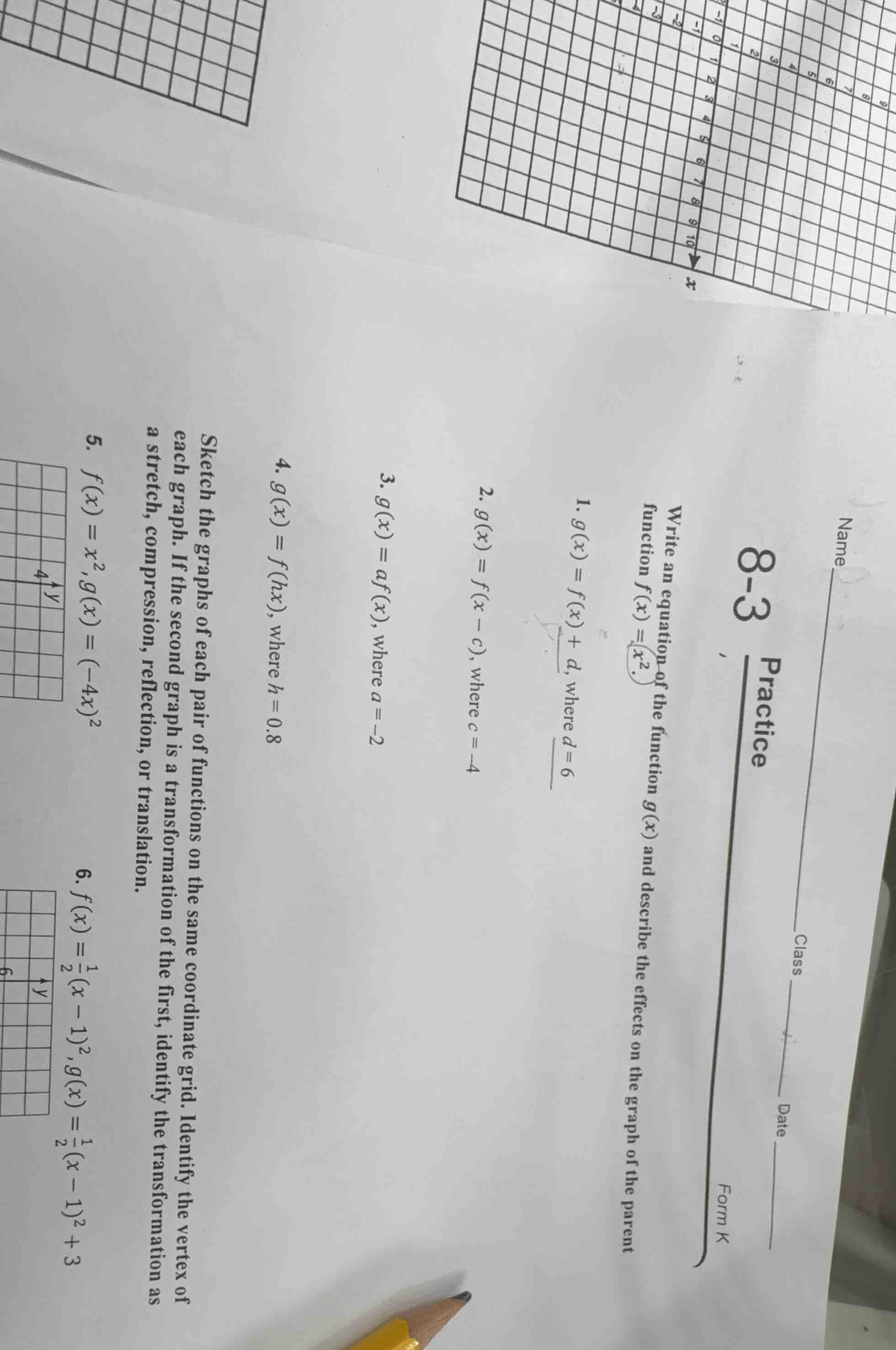
write an equation of the function $g(x)$ and describe the effects on the graph of the parent function $f(x)=x^2$.
- $g(x)=f(x)+d$, where $d=6$
- $g(x)=f(x-c)$, where $c=-4$
- $g(x)=af(x)$, where $a=-2$
- $g(x)=f(hx)$, where $h=0.8$
sketch the graphs of each pair of functions on the same coordinate grid. identify the vertex of each graph. if the second graph is a transformation of the first, identify the transformation as a stretch, compression, reflection, or translation.
- $f(x)=x^2, g(x)=(-4x)^2$
- $f(x)=\frac{1}{2}(x-1)^2, g(x)=\frac{1}{2}(x-1)^2+3$
Step1: Substitute $f(x)=x^2$ into $g(x)$
$g(x) = x^2 + 6$
Step2: Substitute $f(x)=x^2$ into $g(x)$
$g(x) = (x - (-4))^2 = (x+4)^2$
Step3: Substitute $f(x)=x^2$ into $g(x)$
$g(x) = -2x^2$
Step4: Substitute $f(x)=x^2$ into $g(x)$
$g(x) = (0.8x)^2 = 0.64x^2$
Step5: Rewrite $g(x)$ and identify transformation
$g(x) = (-4x)^2 = 16x^2$
Step6: Compare $g(x)$ to $f(x)$ for transformation
$g(x) = \frac{1}{2}(x-1)^2 + 3$

Snap & solve any problem in the app
Get step-by-step solutions on Sovi AI
Photo-based solutions with guided steps
Explore more problems and detailed explanations
- $g(x)=x^2+6$; The graph of the parent function $f(x)=x^2$ is translated 6 units upward. Vertex of $f(x)$ is $(0,0)$, vertex of $g(x)$ is $(0,6)$.
- $g(x)=(x+4)^2$; The graph of the parent function $f(x)=x^2$ is translated 4 units to the left. Vertex of $f(x)$ is $(0,0)$, vertex of $g(x)$ is $(-4,0)$.
- $g(x)=-2x^2$; The graph of the parent function $f(x)=x^2$ is reflected over the x-axis and vertically stretched by a factor of 2. Vertex of $f(x)$ is $(0,0)$, vertex of $g(x)$ is $(0,0)$.
- $g(x)=(0.8x)^2=0.64x^2$; The graph of the parent function $f(x)=x^2$ is horizontally compressed by a factor of $\frac{1}{0.8}=1.25$. Vertex of $f(x)$ is $(0,0)$, vertex of $g(x)$ is $(0,0)$.
- $g(x)=(-4x)^2=16x^2$; The graph of the parent function $f(x)=x^2$ is horizontally compressed by a factor of $\frac{1}{4}$ (the negative sign results in a reflection over the y-axis, but since $x^2$ is even, this has no visible change). Vertex of $f(x)$ is $(0,0)$, vertex of $g(x)$ is $(0,0)$.
- $g(x)=\frac{1}{2}(x-1)^2+3$; The graph of the parent function $f(x)=\frac{1}{2}(x-1)^2$ is translated 3 units upward. Vertex of $f(x)$ is $(1,0)$, vertex of $g(x)$ is $(1,3)$.
(Note: For the graphing portions, plot the vertex and additional points (e.g., $x=\pm1, \pm2$ for parent functions) to sketch each transformed curve on the provided grids.)