QUESTION IMAGE
Question
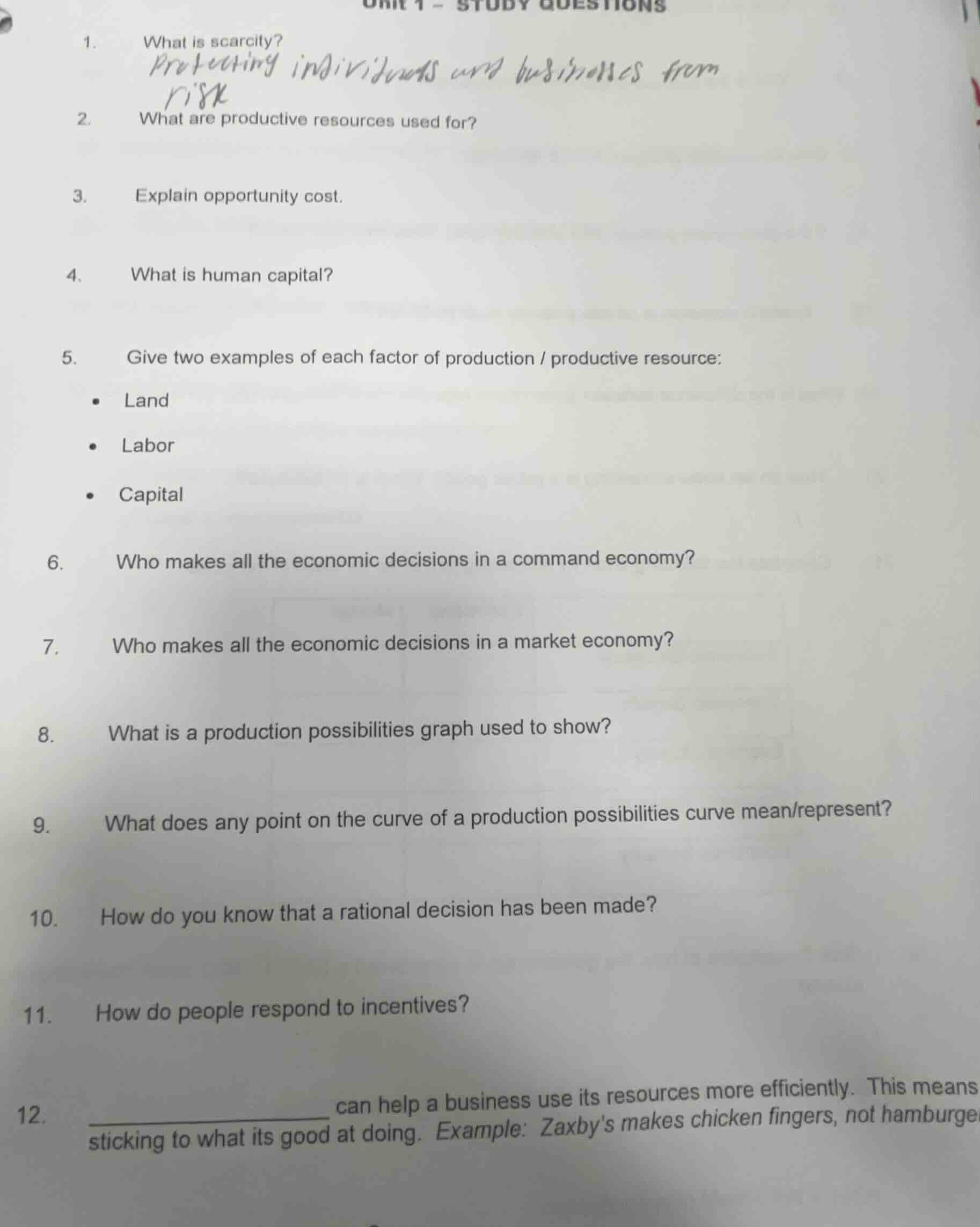
unit 1 - study questions
- what is scarcity?
- what are productive resources used for?
- explain opportunity cost.
- what is human capital?
- give two examples of each factor of production / productive resource:
- land
- labor
- capital
- who makes all the economic decisions in a command economy?
- who makes all the economic decisions in a market economy?
- what is a production possibilities graph used to show?
- what does any point on the curve of a production possibilities curve mean/represent?
- how do you know that a rational decision has been made?
- how do people respond to incentives?
- ______________ can help a business use its resources more efficiently. this means sticking to what its good at doing. example: zaxbys makes chicken fingers, not hamburge
Brief Explanations
- Defined as the fundamental economic condition where unlimited human wants exceed limited available resources.
- Used to produce goods and services to satisfy consumer wants.
- The value of the next-best alternative that is forgone when making a choice.
- The knowledge, skills, education, and experience that workers possess, which boosts their productive capacity.
- Examples tied to core production factors:
- Land: Natural resources for production
- Labor: Human effort in production
- Capital: Man-made production tools
- Centralized government/state authority controls all economic choices.
- Private individuals and businesses (driven by supply/demand) make choices.
- Illustrates maximum output combinations of two goods with fixed resources.
- Represents efficient full utilization of available resources.
- When the marginal benefit of a choice equals or exceeds its marginal cost.
- People act to pursue rewards and avoid penalties, adjusting behavior to gain benefits or reduce losses.
- Focusing on a specific production task to boost efficiency, matching the given example.

Snap & solve any problem in the app
Get step-by-step solutions on Sovi AI
Photo-based solutions with guided steps
Explore more problems and detailed explanations
- Scarcity is the basic economic problem where unlimited human wants and needs exceed the limited resources available to fulfill them.
- Productive resources are used to produce goods and services that satisfy people's wants and needs.
- Opportunity cost is the value of the best alternative that is given up when a choice is made (the next-best foregone option).
- Human capital refers to the knowledge, skills, education, and experience that workers acquire, which increases their ability to produce goods and services.
5.
- Land: Oil reserves, agricultural farmland
- Labor: A teacher's classroom instruction, a construction worker's physical labor
- Capital: A factory assembly line, a delivery truck
- The central government (or a centralized authority/state planners) makes all economic decisions in a command economy.
- Private individuals and businesses (driven by supply and demand in free markets) make all economic decisions in a market economy.
- A production possibilities graph is used to show the maximum combinations of two goods or services that can be produced with a fixed amount of resources and technology.
- Any point on the production possibilities curve represents an efficient level of production, where all available resources are fully and optimally used to produce a combination of goods.
- A rational decision is made when the marginal benefit of the choice is greater than or equal to the marginal cost of that choice.
- People respond to incentives by changing their behavior: they tend to pursue actions that offer rewards (positive incentives) and avoid actions that result in penalties (negative incentives).
- Specialization