QUESTION IMAGE
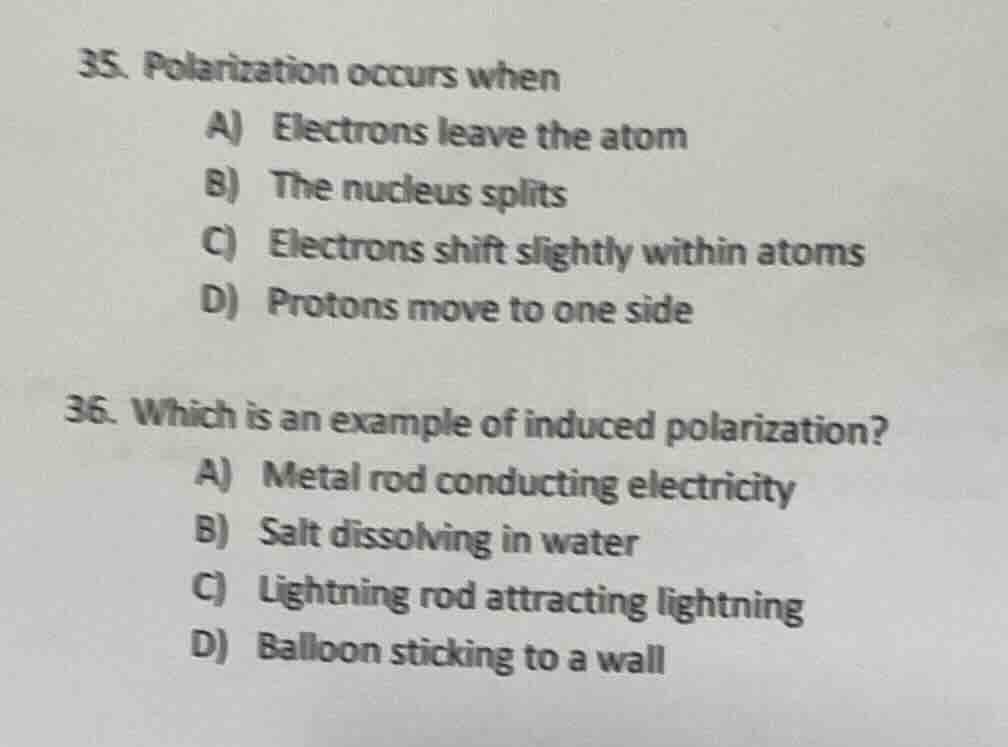
Question
- polarization occurs when
a) electrons leave the atom
b) the nucleus splits
c) electrons shift slightly within atoms
d) protons move to one side
- which is an example of induced polarization?
a) metal rod conducting electricity
b) salt dissolving in water
c) lightning rod attracting lightning
d) balloon sticking to a wall
Response
Question 35
Brief Explanations
To determine when polarization occurs, we analyze each option:
- Option A: Electrons leaving the atom is ionization, not polarization.
- Option B: The nucleus splitting is nuclear fission, unrelated to polarization.
- Option C: Polarization in dielectrics involves electrons shifting slightly within atoms (or molecules) due to an external electric field, creating a separation of charge.
- Option D: Protons are in the nucleus and do not move easily; polarization involves electron (or charge) shifts, not proton movement.
Brief Explanations
To identify induced polarization, we analyze each option:
- Option A: A metal rod conducting electricity involves free electron flow (conduction), not polarization (which is more about dielectric materials).
- Option B: Salt dissolving in water is dissociation into ions, not polarization.
- Option C: A lightning rod attracting lightning is about charge concentration (using sharp points), not induced polarization.
- Option D: A balloon (after being rubbed, becoming charged) induces a slight charge separation (polarization) in the neutral wall, causing attraction (sticking). This is induced polarization.

Snap & solve any problem in the app
Get step-by-step solutions on Sovi AI
Photo-based solutions with guided steps
Explore more problems and detailed explanations
C) Electrons shift slightly within atoms