QUESTION IMAGE
Question
introduction: chemical equations show how compounds and elements react with one another. an element is a substance consisting of one kind of atom, such as aluminum (al) or oxygen (o₂). a compound is a substance made of more than one kind of atom, such as water (h₂o) or table salt (nacl).
question: how are chemical reactions classified?
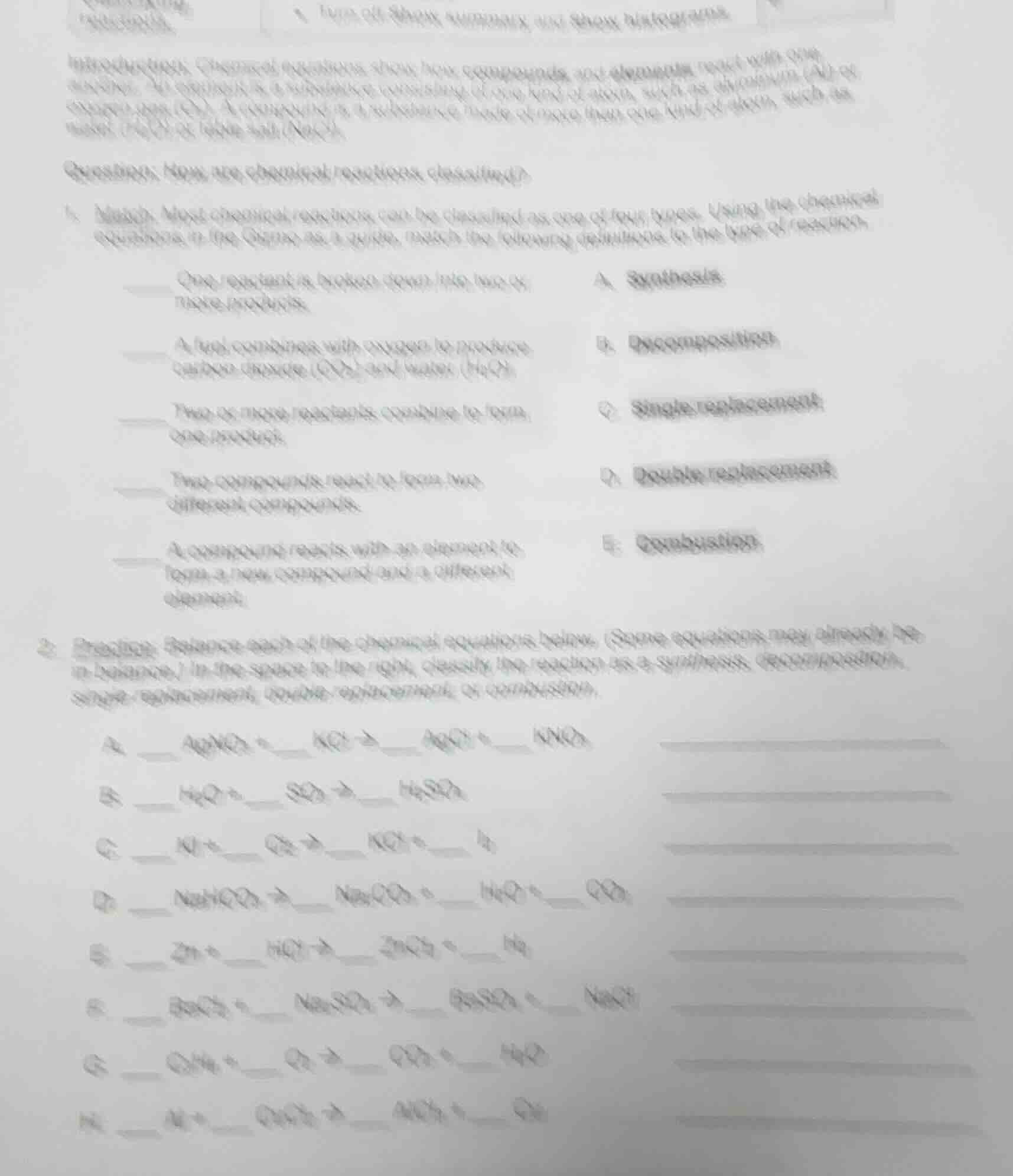
- match: most chemical reactions can be classified as one of four types. using the chemical equations in the chapter as a guide, match the following descriptions to the type of reaction
____ one reactant is broken down into two or more products. a. synthesis
____ a fuel combines with oxygen to produce carbon dioxide (co₂) and water (h₂o). b. decomposition
____ two or more reactants combine to form one product. c. single replacement
____ two compounds react to form two different compounds. d. double replacement
____ a compound reacts with an element to form a new compound and a different element. e. combustion
- practice: balance each of the chemical equations below. (some equations may already be in balance.) in the space to the right, classify the reaction as a synthesis, decomposition, single replacement, double replacement, or combustion.
a. _ agno₃ + _ kcl → _ agcl + _ kno₃
b. _ h₂o + _ so₃ → ___ h₂so₄
c. _ ki + _ cl₂ → _ kcl + _ i₂
d. _ nahco₃ → _ na₂co₃ + _ h₂o + _ co₂
e. _ zn + _ hcl → _ zncl₂ + _ h₂
f. _ ba(oh)₂ + _ na₂so₄ → _ baso₄ + _ naoh
g. _ ch₄ + _ o₂ → _ co₂ + _ h₂o
h. _ al + _ o₂ → _ al₂o₃ + _ o₂
Part 1: Matching
- Decomposition: A reaction where one reactant breaks into two or more products. So "One reactant is broken down into two or more products" matches B. Decomposition.
- Combustion: A fuel (like a hydrocarbon) combines with oxygen to produce \(CO_2\) and \(H_2O\). So "A fuel combines with oxygen to produce carbon dioxide (\(CO_2\)) and water (\(H_2O\))" matches E. Combustion.
- Synthesis: Two or more reactants combine to form one product. So "Two or more reactants combine to form one product" matches A. Synthesis.
- Double Replacement: Two compounds react to form two different compounds (ions swap). So "Two compounds react to form two different compounds" matches D. Double Replacement.
- Single Replacement: A compound reacts with an element to form a new compound and a different element (one element replaces another in a compound). So "A compound reacts with an element to form a new compound and a different element" matches C. Single Replacement.
Step1: Check atoms. Ag: 1 on left, 1 on right. N: 1 on left, 1 on right. O: 3 on left, 3 on right. K: 1 on left, 1 on right. Cl: 1 on left, 1 on right. So already balanced. Coefficients: 1, 1, 1, 1.
Step2: Reaction type: Double Replacement (ions \(Ag^+\) & \(K^+\) swap with \(NO_3^-\) & \(Cl^-\)).
Step1: Check atoms. H: 2 on left, 2 on right. O: 1 + 3 = 4 on left, 4 on right. S: 1 on left, 1 on right. Balanced. Coefficients: 1, 1, 1.
Step2: Reaction type: Synthesis (two reactants form one product).

Snap & solve any problem in the app
Get step-by-step solutions on Sovi AI
Photo-based solutions with guided steps
Explore more problems and detailed explanations
- B. Decomposition
- E. Combustion
- A. Synthesis
- D. Double Replacement
- C. Single Replacement
Part 2: Balancing and Classifying
A. \(AgNO_3 + KCl
ightarrow AgCl + KNO_3\)