QUESTION IMAGE
Question
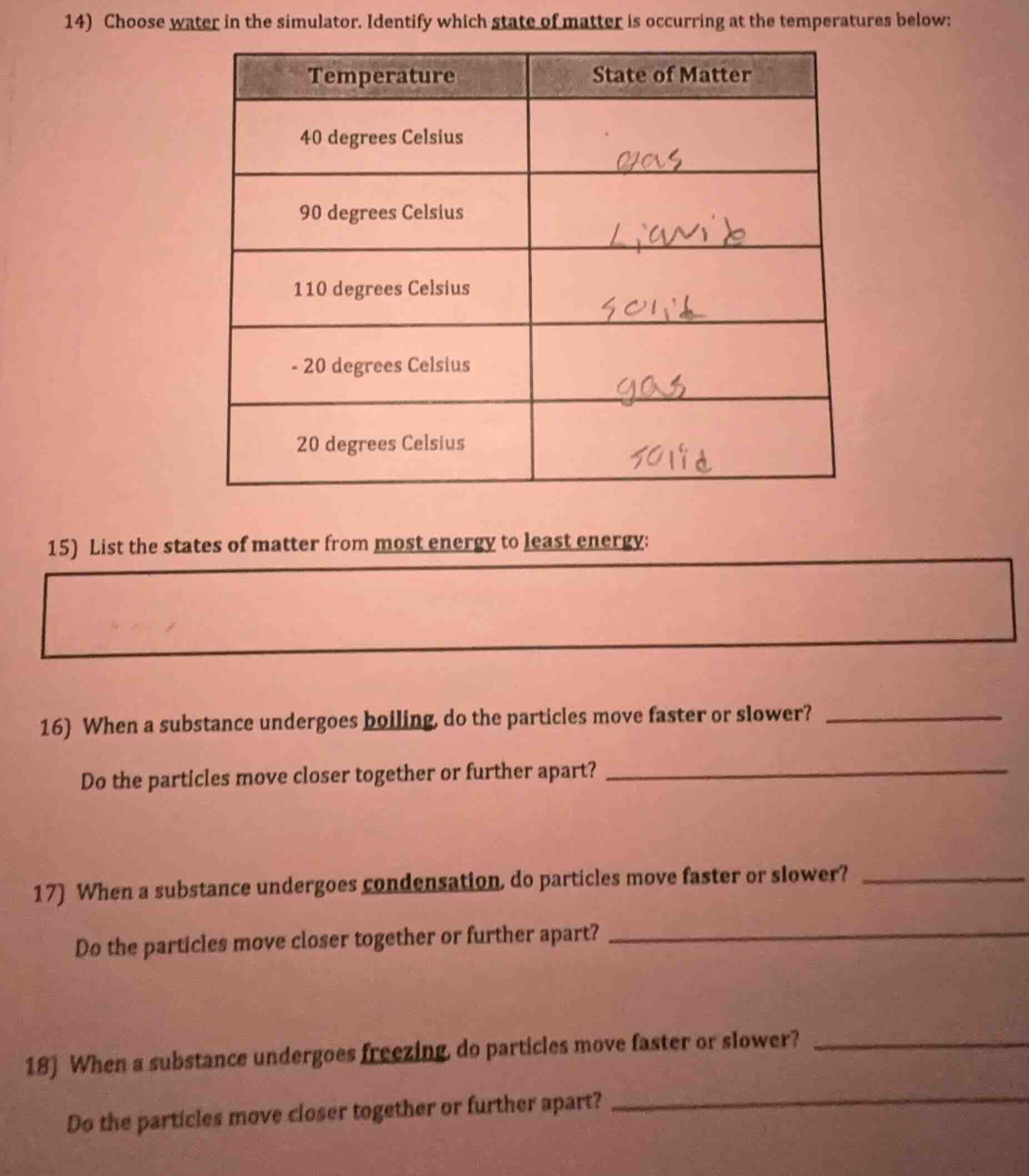
- choose water in the simulator. identify which state of matter is occurring at the temperatures below:
| temperature | state of matter |
|---|---|
| 90 degrees celsius | liquid |
| 110 degrees celsius | solid |
| -20 degrees celsius | gas |
| 20 degrees celsius | solid |
- list the states of matter from most energy to least energy:
blank
- when a substance undergoes boiling, do the particles move faster or slower? blank
do the particles move closer together or further apart? blank
- when a substance undergoes condensation, do particles move faster or slower? blank
do the particles move closer together or further apart? blank
- when a substance undergoes freezing, do particles move faster or slower? blank
do the particles move closer together or further apart? blank
Question 14 (Correcting the State of Matter for Water at Given Temperatures)
Step 1: Recall Water's Phase Transitions
Water freezes at \(0^\circ \text{C}\) (becomes solid, ice) and boils at \(100^\circ \text{C}\) (becomes gas, steam). At temperatures between \(0^\circ \text{C}\) and \(100^\circ \text{C}\), water is liquid. Below \(0^\circ \text{C}\), it is solid; above \(100^\circ \text{C}\), it is gas.
Step 2: Analyze Each Temperature
- \(40^\circ \text{C}\): Between \(0^\circ \text{C}\) and \(100^\circ \text{C}\) → Liquid
- \(90^\circ \text{C}\): Between \(0^\circ \text{C}\) and \(100^\circ \text{C}\) → Liquid
- \(110^\circ \text{C}\): Above \(100^\circ \text{C}\) → Gas
- \(-20^\circ \text{C}\): Below \(0^\circ \text{C}\) → Solid (Ice)
- \(20^\circ \text{C}\): Between \(0^\circ \text{C}\) and \(100^\circ \text{C}\) → Liquid
In the gaseous state, particles move freely and rapidly, having the highest kinetic energy. In the liquid state, particles have moderate energy (more than solids, less than gases). In the solid state, particles vibrate in fixed positions, having the lowest kinetic energy. So the order from most to least energy is gas, liquid, solid.
Boiling is the transition from liquid to gas (vaporization at boiling point). During boiling, heat is added, increasing the kinetic energy of particles. So particles move faster (higher energy) and spread out, moving further apart (as gas has more space between particles than liquid).

Snap & solve any problem in the app
Get step-by-step solutions on Sovi AI
Photo-based solutions with guided steps
Explore more problems and detailed explanations
(Corrected Table):
| Temperature | State of Matter |
|---|---|
| 90 degrees Celsius | Liquid |
| 110 degrees Celsius | Gas |
| -20 degrees Celsius | Solid (Ice) |
| 20 degrees Celsius | Liquid |